Software Engineer and Data Scientist are two of the most talked-about job titles in tech. Both promise strong career opportunities, high pay, and the chance to solve real-world problems.
But, here’s the twist: they are not the same. One is about building and maintaining software products, while the other is about turning messy data into knowledge.
The big question is: which one fits your mindset better? This guide breaks it down so you can see where your skills and passions align.

A Software Engineer is like a builder who creates the applications and systems we rely on every single day. Their work is logical, structured, and product-driven. If you enjoy constructing things that people can use directly, this role may resonate with you.
The main responsibilities of a software engineer include:
Think of a software engineer at ASOS. Their job might be to make sure the e-commerce website can handle thousands of shoppers rushing to grab deals during a flash sale. The systems they build need to be fast, reliable, and secure.

A Data Scientist is more like an investigator. Instead of building tools for users, they dig into information to uncover patterns and guide business decisions. They use math, coding, and statistics to answer big questions.
The main responsibilities of a data scientist include:
A data scientist at ASOS might look at purchase history to predict which clothing styles will trend next season. This helps the company stock the right products at the right time.
Projects in software engineering and data science may both involve coding and problem-solving, but the way they unfold is very different. One follows a structured path, while the other leans into experimentation and uncertainty.
Software engineering projects usually move through a well-organized process with clear steps.
Data science projects, on the other hand, resemble experiments where the outcome is less predictable.
While both careers involve problem-solving and coding, the way each professional thinks and works is noticeably different. The table below highlights the core contrasts between software engineers and data scientists.
| Aspect | Software Engineer | Data Scientist |
| Primary Goal | Build and maintain software that people can use reliably | Extract insights from data to guide decisions |
| Core Mindset | “How do I design this system so it’s efficient, scalable, and stable?” | “What story does this data tell, and how can it answer key questions?” |
| Workflow | Structured and linear (Design → Build → Test → Deploy) | Iterative and experimental (Hypothesis → Experiment → Analyse → Conclude) |
| End Product | A tangible application, feature, or system | An analysis, report, visualization, or predictive model |
| Measure of Success | Reliable performance, minimal downtime, strong user adoption | Business impact of insights and accuracy of predictions |
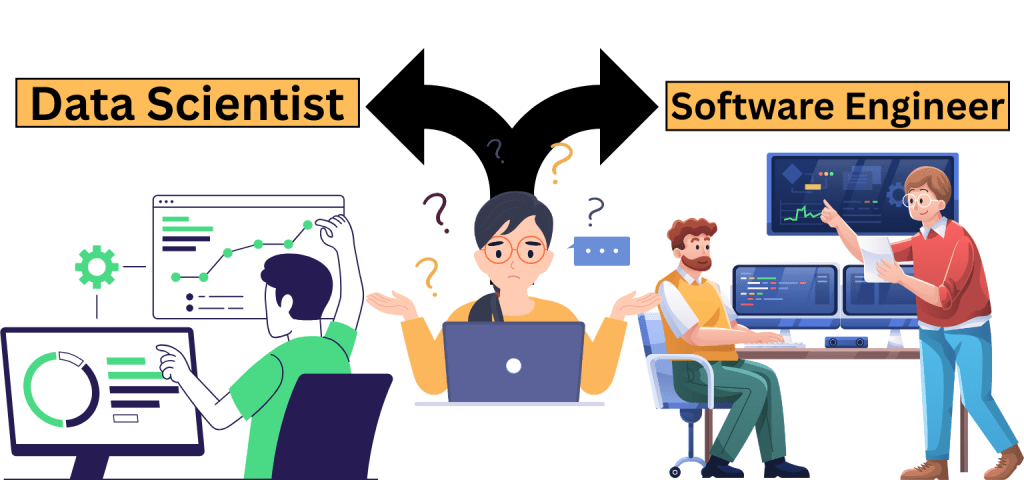
Both data science and software engineering offer rewarding career paths, but they differ in availability of roles, entry requirements, and growth opportunities.
Understanding the strengths and trade-offs of each can help you decide which aligns best with your goals.
Data science roles often sit at the intersection of business and technology, where insights directly influence strategy. This can make the role highly impactful and, in many cases, lead to a higher average starting salary compared to software engineering.
Data scientists also get early exposure to advanced fields like artificial intelligence and machine learning, which can be exciting for those who enjoy innovation.
On the flip side, the job market for data scientists is narrower and more competitive. Employers usually expect a strong background in statistics and mathematics, and projects do not always lead to concrete results.
Instead of a finished product, success might be measured by the clarity or usefulness of an insight, which can feel less predictable.
Software engineering offers a broader set of opportunities across almost every industry. From healthcare and finance to e-commerce and gaming, companies need engineers to build and maintain their systems.
This translates into more job openings and a highly transferable skill set. Career progression is also clearer, with roles ranging from junior developer to architect or engineering manager.
The trade-off is that average starting salaries can sometimes be slightly lower compared to data science, especially outside of major tech hubs.
In addition, unless you move into specialized roles, the day-to-day work may not involve advanced analytics or machine learning. For those who enjoy pure coding and system design, though, this can be an advantage rather than a drawback.
Salaries and career opportunities in the United States vary by region, industry, and company size, but both fields continue to show strong demand nationwide.
In short, both paths offer security and growth, but software engineering provides wider entry points while data science offers higher influence on business strategy for those with the right technical foundation.
The easiest way to figure out which career path feels right is to actually try the work. A short weekend project can give you a real taste of what it’s like to think like a data scientist or a software engineer.
If you’re curious about data science, grab a dataset from a site like Kaggle, which has plenty of public U.S.-based data. For example, you might download the U.S. Traffic Accident Dataset and ask a question, such as: “Do accidents increase during snowstorms in Minnesota?”
With your question in mind, open up a Jupyter Notebook and use Python to clean and analyze the data. Create a simple chart or graph to visualize your findings.
The excitement here comes from discovery…spotting patterns in messy information and turning them into insights. If you enjoy that process, data science could be your lane.
If software engineering sounds more appealing, focus on building something you can see and use. Set a goal such as creating a personal portfolio website or a basic to-do list app. Using HTML, CSS, and JavaScript, you’ll design the look, add functionality, and test your project.
When it’s ready, put it online with a free service like GitHub Pages. There’s real satisfaction in seeing your code come to life as a working product. If you enjoy the structured process of building from the ground up, software engineering might be the better match for you.
Both careers offer rewarding opportunities, but the better choice depends on what excites you the most. Think about how you prefer to solve problems and what kind of work gives you the most satisfaction.
If your curiosity drives you to ask questions and dig beneath the surface, data science could be a natural fit.
If you thrive on structured problem-solving and the joy of building, software engineering may be the better choice.
Think of it this way: software engineers build the car, while data scientists study the data it generates to guide the journey ahead. These two roles often work hand in hand, with engineers creating the systems and pipelines that scientists rely on for analysis.
Both paths are rewarding and vital in shaping technology. By recognizing whether your passion lies in building or in discovery, you can choose the direction that best fits your strengths and ambitions.

